
How Do Professionals Remove Stains from Carpet?

Professional carpet stain removal follows a structured process that goes far beyond household sprays and scrubbing. Here’s how trained technicians approach stubborn stains:
- Stain Identification — Determine stain type, age, and fibre compatibility before selecting any treatment
- Colourfastness Testing — Test carpet or fabric to confirm treatment won’t cause damage or discolouration
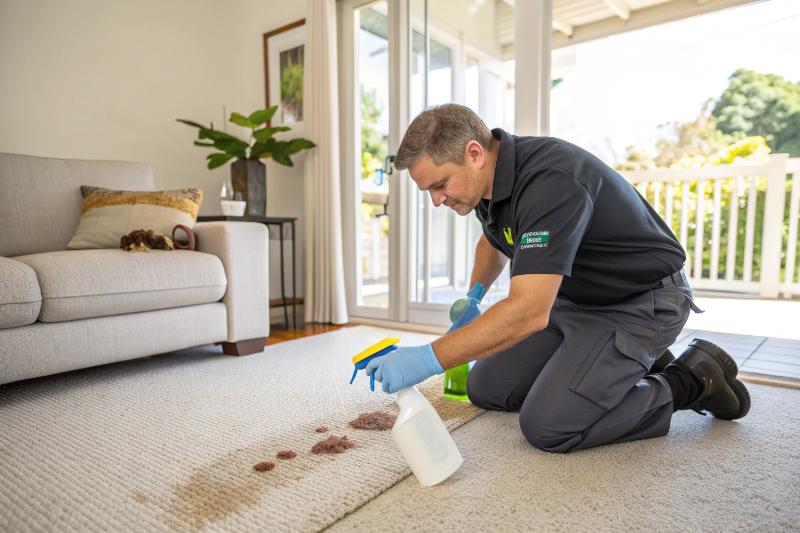
- Targeted Pre-Treatment — Apply a specialist chemical formulated specifically for that stain type (enzyme-based for biologicals, solvent-based for ink or grease)
- Controlled Agitation — Gentle working of product into fibres — never scrubbing, which spreads stains and damages carpet
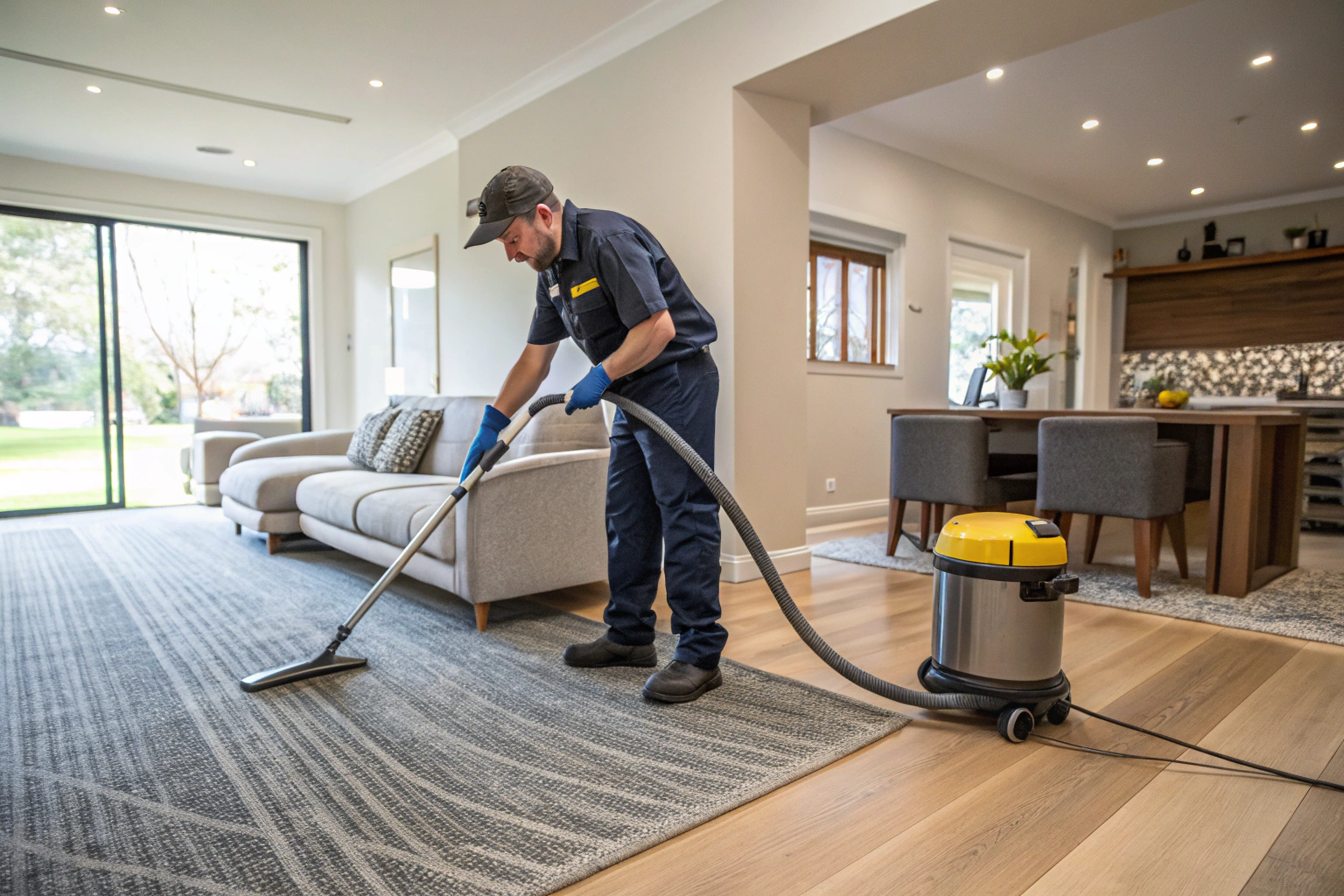
- Hot Water Extraction — High-powered equipment lifts stain and solution from deep within carpet fibres
- Residue Neutralisation — Remove all chemical residue to prevent rapid re-soiling
- Results Assessment — Evaluate outcome and retreat where necessary
Professional products penetrate deeper and work faster than retail alternatives — often succeeding where DIY has already failed.

Every Stain Is Different — And Needs Different Treatment
Here’s something the back of a supermarket spray bottle won’t tell you: using the wrong treatment on the wrong stain can make it permanent.
Stains fall into distinct categories — protein-based stains like blood or egg, tannin stains like red wine and coffee, and solvent-based stains like ink or nail polish — and each one responds to completely different chemistry. What breaks down a coffee stain will set a blood stain. What lifts grease will do nothing for a tannin mark.
This is where DIY stain removal goes wrong most often. Not from lack of effort — from reaching for the closest product without knowing what’s actually in the carpet fibres. Our technicians identify the stain type first, then match the treatment to it. That assessment step, the one most people skip, is what separates lifting a stain from locking it in forever.
Stains We Remove — From the Common to the Stubborn
Professional Odour Elimination — Not Masking, Removing
A lot of cleaning products smell like they’re working. That’s about all they’re doing.
Fragrance masks odour at the surface level. It doesn’t remove the source. That’s why the smell comes back — sometimes within hours of treatment.
Common Odours We Treat: Pet urine, cigarette smoke, musty and mildew smells, vomit, food odours, and general stale household smells — particularly persistent in Newcastle homes where coastal humidity drives them deep into fibres.
Enzyme-Based Treatment Explained: Enzyme treatments break down odour-causing organic matter at a molecular level — bacteria, urine salts, food particles — rather than masking with fragrance. The source is gone, not hidden.
When Underlay Is the Real Problem: Deep spills penetrate past the carpet into the underlay and subfloor. Surface treatment alone won’t reach it. Our deep extraction pulls contamination from much further down — which is why persistent odours often respond to a single professional treatment.
Why DIY Stain Removal Usually Makes Things Worse
Nobody sets out to make a stain worse. But the most common DIY moves do exactly that.
Rubbing instead of blotting spreads the stain wider and pushes it deeper into the fibres. Hot water on a protein stain — blood, egg, dairy — sets it permanently. A coloured cloth transfers dye into the carpet. Too much liquid over-wets the backing, creating mould and odour problems that outlast the original stain.
Then there’s soap residue. You scrub, the stain looks better, and within a week, there’s a new dark patch forming in the same spot. That’s dirt being attracted to detergent left behind in the fibres — a problem that compounds every time someone walks across it.
The frustrating part is that most of these mistakes are completely understandable. The information on the product label isn’t wrong — it’s just not written for your specific stain type, your carpet fibre, or Newcastle’s humidity levels. By the time a professional arrives, we’re often treating the original stain plus the damage done trying to fix it.
The sooner we get to a stain, the better the outcome. But even failed DIY attempts aren’t always the end of the story.

Honest Expectations — What We Can and Can't Remove
We’d rather tell you the truth upfront than take your money and deliver a result you’re not happy with.
Most stains — even stubborn, long-standing ones — respond well to professional treatment. But some won’t come out completely, and pretending otherwise doesn’t help anyone.
Bleach spots aren’t stains — they’re permanent colour loss, and no cleaning product restores dye that’s already been destroyed. Heat-set stains, where someone has applied a hot cloth or steam iron trying to lift a spill, are often locked into the fibre permanently. Dye transfers from coloured fabrics or cheap rugs can penetrate deep enough that full removal isn’t possible without risking damage to the carpet itself.
When we assess your stain before treatment, we’ll tell you honestly what outcome to expect — full removal, significant improvement, or partial fading. If a stain doesn’t respond to treatment and it’s part of a larger clean, we won’t charge separately for the attempt. No surprises, no inflated expectations, no bill for a result we couldn’t deliver.
That kind of honesty is harder to find than it should be.
What To Do Immediately After a Spill (Before We Arrive)
The first five minutes after a spill matter more than anything that comes after. Here’s how to give the stain the best possible chance of full removal.
The Right Way to Blot
Use a clean white cloth and work from the outside of the spill towards the centre — this stops the stain spreading outward. Press and lift, press and lift. Cold water helps dilute most fresh spills. The goal is to absorb as much of the spill as possible without pushing it deeper into the fibres.
What Never to Do
- No rubbing — it spreads the stain and damages carpet fibres
- No hot water on protein stains like blood, egg, or vomit
- No coloured cloths — dye transfer is a real risk
- No random cleaning products — wrong chemistry sets stains permanently
- No over-wetting — excess moisture soaks into the backing and causes mould
When to Call Us Immediately
Fresh stains, large spills, any biological stain, valuable carpets or upholstery, and anything where a DIY attempt has already been made. The faster we get to it, the better the result — same-day response is available across Newcastle and Lake Macquarie.
Stain Removal for Carpets vs. Upholstery — Key Differences
Same stain, different surface — and the treatment approach changes completely.
Carpets are generally more forgiving. They tolerate more moisture, heavier extraction equipment, and stronger chemical treatments without risk of damage.
Upholstery is a different story. Fabric sensitivities vary enormously — delicate natural fibres like wool, silk, and cotton can shrink, bleed, or distort with the wrong product. Moisture tolerance is much lower, requiring lighter application and gentler extraction to avoid soaking the foam or frame underneath.
Colourfastness is a bigger concern, too. Many fabric dyes aren’t as stable as carpet dyes, and an untested chemical can cause irreversible discolouration on a lounge suite worth thousands to replace.
Our technicians assess fabric type before any product touches the surface — whether it’s carpet in Charlestown or a linen sofa in Merewether.
Frequently Asked Questions
Most individual stain treatments take 15–30 minutes, depending on stain type, size, and how long it’s been there. A full carpet stain and odour treatment for an average Newcastle home typically runs 1–2 hours.
Often yes. Age makes stains harder to remove, but not always impossible. We assess each stain honestly before treatment and tell you upfront what outcome to expect.
Not necessarily. We offer unattended service options with secure lockbox arrangements. We’ll send you an SMS when we arrive and when we’re done.
If we’ve removed the stain and neutralised all chemical residue properly, it shouldn’t return. Reappearing stains are usually caused by soap residue left behind from a previous DIY attempt — something we address as part of our treatment process.
Yes. We use products that are safe for children and pets once dry. We’ll advise you on drying times before we leave, so you know exactly when the treated area is ready to use.
We’ll tell you before we start if we think full removal is unlikely. If a stain doesn’t respond to treatment and it’s part of a larger clean, we won’t charge separately for the attempt.
Yes. We treat both carpets and upholstery across Newcastle and Lake Macquarie. Fabric type and construction are assessed before any product is applied to protect against discolouration or damage.
Local Cleaners you can Rely on in Newcastle, NSW.
