
Why Does Pet Urine Smell Keep Coming Back After Cleaning?
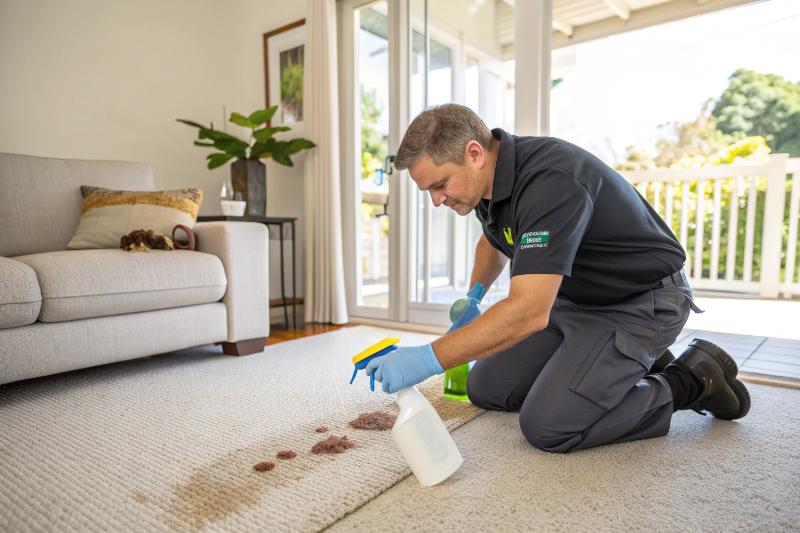
Pet urine odour returns after cleaning because urine penetrates through carpet fibres into the padding and subfloor — well beyond where standard cleaning can reach.
Here’s why the smell keeps coming back:
- Uric acid crystals bond deep into carpet, padding and subfloor and can’t be removed with regular cleaning products.
- Moisture reactivates odour — steam cleaning, shampooing and even Newcastle’s coastal humidity cause dormant crystals to release odour again.
- Bacteria multiply over time — untreated urine becomes a growing source of ammonia and allergens.
- Pets re-mark the same spots — their nose detects residual odour even after you’ve cleaned, triggering repeated accidents in the same area.
Complete odour elimination requires professional enzyme treatment that breaks down uric acid crystals at a molecular level — combined with UV detection to locate every affected area, including hidden accidents invisible to the naked eye.

Why Pet Stains Are Different From Regular Carpet Stains
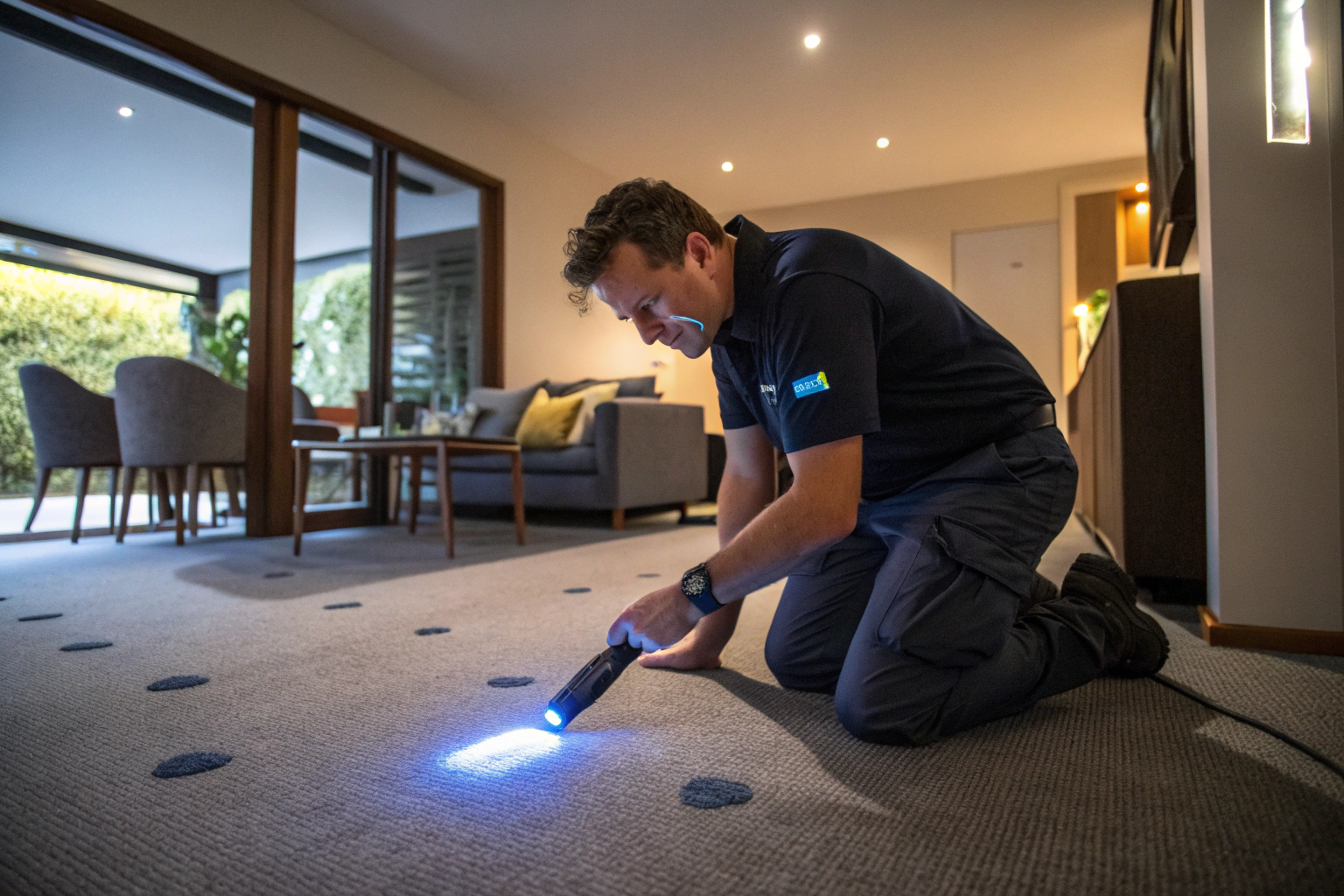
UV Black Light Detection – Finding Every Hidden Accident
What UV Detection Reveals: Dried pet urine is invisible under normal light — but under a UV black light, it glows clearly. Before we treat anything, we map every affected area across your entire carpet. That includes old accidents you’ve forgotten about, spots hidden under furniture, and areas your pet has been quietly using for months.
Why Most Properties Have More Than Owners Realise: Pets are creatures of habit. They return to the same spots repeatedly, and many accidents go unnoticed for months — especially under beds, behind lounges, and along skirting boards. Most properties we inspect have two to three times more affected areas than the owners were aware of before we arrived.
Our Pet Stain and Odour Treatment Process
Step 1 – Assessment and UV Mapping: Before any treatment begins, we do a full UV inspection of the affected areas. We map every contaminated zone — noting severity, penetration depth, and which areas need standard treatment versus a more intensive approach. No guesswork, no missed spots.
Step 2 – Enzyme Treatment and Dwell Time: We apply a professional-grade enzyme formula directly to every affected area. The enzymes break down uric acid crystals at a molecular level — permanently eliminating the odour source rather than masking it. The solution needs time to work, so we allow full dwell time before moving to extraction.
Step 3 – Deep Extraction: Once the enzyme treatment has done its job, we extract the broken-down contamination from the carpet and padding using professional extraction equipment. This pulls the treated urine deposits out of the fibres — not just off the surface.
Step 4 – Deodorisation and Final Treatment: After extraction, we apply a final deodorising treatment to neutralise any remaining odour and leave the carpet fresh. For severe cases, this step may include a secondary enzyme application or a specialised odour neutraliser targeting deeper contamination.
Treatment Levels – What Your Carpets Actually Need
Not every pet stain situation is the same — and we won’t treat them like they are.
After our UV inspection and assessment, we’ll give you an honest recommendation based on what we actually find. There are three general levels of treatment:
| Treatment Level | What It Addresses | Best For |
|---|---|---|
| Surface Treatment | Carpet fibres and backing | Recent accidents, light staining, minimal odour |
| Deep Treatment | Carpet, backing and padding | Repeated accidents, stronger odour, multiple affected areas |
| Severe Case Treatment | Carpet, padding and subfloor | Long-term contamination, heavy re-marking, padding saturation |
We won’t push you toward a more expensive treatment if your carpets don’t need it. And we won’t under-treat a severe case just to keep the price down — because that means the smell comes back and you’re paying twice.
Stopping Pet Re-Marking Behaviour
Why Pets Return to the Same Spot: Pets don’t re-mark out of stubbornness. Their sense of smell is exponentially more powerful than ours — and as long as uric acid residue remains in the carpet, their nose tells them that’s an acceptable toilet spot. Regular cleaning doesn’t remove enough of the odour signal to break that association.
How Complete Odour Elimination Breaks the Cycle: When enzyme treatment fully breaks down the uric acid crystals, the odour signal disappears at a level your pet can actually detect. No residual smell means no trigger to return to that spot. For most pets, complete odour elimination is the single most effective way to stop repeated accidents in the same area — without behavioural training or carpet replacement.

When Padding Replacement Is Necessary
Signs Your Padding Is Beyond Cleaning: Enzyme treatment works well on carpet and lightly contaminated padding. But when urine has saturated the padding repeatedly over a long period, the contamination goes too deep for treatment alone to fully resolve. Signs your padding may need replacing include persistent odour after professional cleaning, visible staining on the padding surface, long-term pet access to the same area, and multiple pets using the same spots over several years.
Our Padding Replacement Process: Where padding replacement is needed, we remove the affected sections, treat the subfloor beneath before installing new padding, and re-lay the carpet over the top. It’s a more involved job — but in severe cases, it’s the only way to permanently eliminate odour at the source. We’ll tell you honestly during assessment whether your situation calls for it, and give you a clear quote before any work begins.
Pet-Safe and Family-Safe Products
This matters — especially in a home with kids, pets, and anyone dealing with allergies or asthma.
The enzyme formula we use is non-toxic, biodegradable, and free from harsh chemicals. It works through a biological process — live enzymes that consume and break down uric acid crystals — rather than masking odour with fragrances or stripping fibres with aggressive solvents.
For Newcastle families dealing with coastal mould allergies or asthma triggers, that distinction is important. You’re not trading one problem for another. The products we use are safe for pets and children to be around once dry — typically within a few hours of treatment completion.
No heavy chemical smell left behind. No residue that irritates sensitive airways. And no compromise on results — the same enzyme formula used in professional healthcare and veterinary facilities worldwide.
If you have specific concerns about allergies, asthma, or chemical sensitivities in your household, mention them when you book. We’ll walk you through exactly what we’re using and why it’s safe for your family.
Frequently Asked Questions
If the smell returns after cleaning, or your pet keeps returning to the same spot, you need enzyme treatment — not a standard clean. We’ll assess the situation honestly and tell you exactly what’s required.
Most jobs take between two and four hours, depending on the number of affected areas and the severity of contamination. We’ll give you a clearer time estimate once we’ve done the UV inspection.
Yes. Once the carpet is dry — typically a few hours after treatment — it’s completely safe for pets and children. Our enzyme formula is non-toxic and leaves no harmful residue.
In most cases, yes. Full odour elimination is achievable with proper enzyme treatment and extraction. In severe cases involving saturated padding, we may recommend padding replacement to get a permanent result.
DIY products and standard carpet cleaning can’t break down uric acid crystals at a molecular level. They lift surface contamination but leave the crystals behind — which reactivate with moisture and heat.
Not necessarily. We offer unattended service options with secure access arrangements. We’ll confirm the details when you book.
We service Newcastle and Lake Macquarie — including Merewether, Charlestown, Warners Bay, Jesmond, New Lambton, Adamstown, Kotara, Belmont, Hamilton, Mayfield, and surrounding suburbs.
Local Cleaners you can Rely on in Newcastle, NSW.
